Hybrid Publishers vs Vanity Press
How to Tell the Difference as an Author
You finally typed “The End.”
Then the doubt crept in.
An email lands in your inbox. A “publisher” loves your manuscript. They want to move fast.
If you’re an American or British writer, it’s an exciting and treacherous moment. If you’re an author, it’s hard to differentiate between Hybrid Publishers and a Vanity Press. On the face of it, they sound the same. Underneath, they are not.
This guide lays it out plainly, without hype or scare tactics. By the end, you’ll know precisely what to seek out and what to flee.
How This Confusion Got Started
Publishing has changed fast.
You no longer have to go through your traditional gatekeepers.” That’s a good thing. But it also left the door open for companies that blur the lines intentionally.
“Hybrid publishers often charge fees.
Vanity presses always charge fees.”
It is that single overlap which leads to confusion and costly errors.
Let’s clear the fog.
What Are Hybrid Publishers Really?
A hybrid publisher is sort-of traditional and sort-of self-publishing.
You invest upfront.
They invest with you.
A real hybrid publisher only gets paid when you do when your book sells.
Legit Hybrid Publishers’ Key Characteristics
- Selective submissions process
- Shared financial risk
- Transparent contracts
- Royalties paid to the author
- Distribution beyond Amazon
They are the people who say no to weak manuscripts. That’s important.
If all are accepted, something is wrong.
What Is a Vanity Press?
Vanity Press serves one purpose: To extract author fees.
- They flatter.
- They rush you.
- They promise bestseller status.
- And then they vanish as soon as you pay.
Common Vanity Press Red Flags
- Guaranteed publication
- No editorial standards
- Vague royalty terms
- Upselling “marketing packages”
- No bookstore distribution
Your book is the product not your reader.
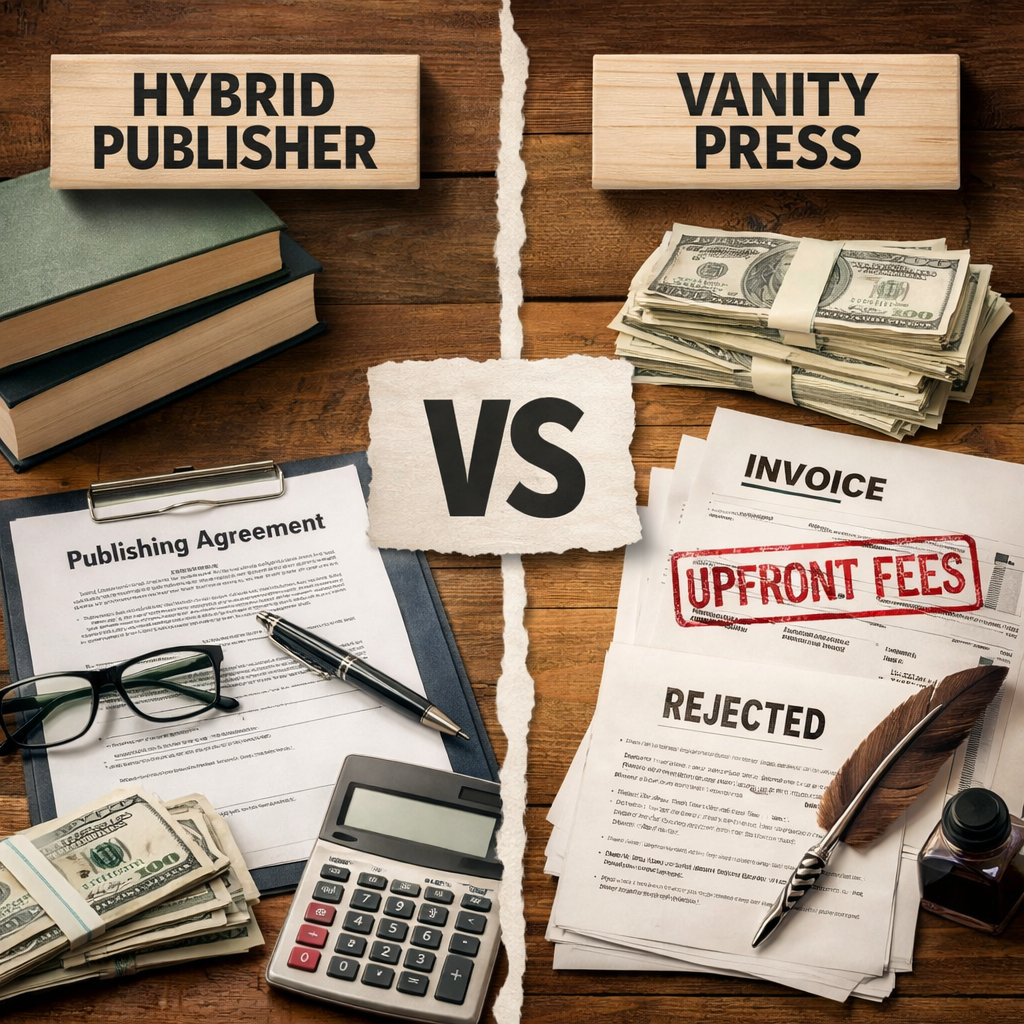
Hybrid Publisher vs Vanity Press: What You Need to Know
Selection Process
- Hybrid publishers review manuscripts seriously.
- Vanity presses accept everything.
- No critique? No edits suggested? That’s a warning.
- Where the Money Comes From
- A hybrid publisher makes their money on book sales.
- Vanity presses make money by charging authors for publishing.
Ask yourself: Whose risk is carried?
- Contract Transparency
- Hybrid deals are clear and equitable.”
- Vanity press agreements are intentionally vague and limiting.
Always read rights clauses carefully.
Distribution & Reach
Hybrid publishers target bookstores, libraries and schools. Vanity presses adhere to print-on-demand services. Wide distribution takes real effort.
Top 5 Legit Hybrid Companies List
- There is no one-size-fits-all stamp of approval.
- But legit companies share patterns.
- How to Validate a Hybrid Publisher
- Member of IBPA or equivalent organisations
- Clear editorial process explained
- Genuine author endorsements that you can appeal to
- Books stocked in independent bookstores
- Transparent pricing pages
- For internal guidance, refer to our resource on
An Open Letter to New Authors with a Short Story Most Don’t Admit to.
U.K. novelist once paid £7,000 to a “publisher.”
- Her book launched quietly.
- No marketing followed.
- Sales stalled at 43 copies.
She would later find out that the company had taken everything everyone submitted.
Hybrid publishers do not operate that way.
- Why Legit Hybrid Publishers Sometimes Say “No”
- This is where a lot of authors fall short.
- Rejection is a good sign.
It means the publisher safeguards its reputation and yours.
No risk of rejection with a Vanity Press.
- A Hybrid Publisher must.
- How to Protect Yourself as a Writer
- Before signing anything, pause.
Then ask these questions:
- Who owns the ISBN?
- Who controls pricing?
- What marketing is included?
- In which venues have your books sold previously?
If answers sound slippery, walk away.
Final Thoughts: Trust the Pattern, Not the Pitch
- Smooth emails are simple to counterfeit.
- Consistent business practices are not.
When you know the difference between a hybrid publisher and Vanity press that fear dissipates.
- Knowledge restores control.
- And your book deserves nothing less than professional cover art.
Frequently Asked Questions
Are all hybrid publishers trustworthy?
No. Some misuse the label. Always verify credentials and contracts.
Is paying to publish always a bad sign?
No Hybrid models are an investment in common. It is the way of making money that’s the problem.
Do vanity presses ever sell books?
Rarely. Most of these are focused on author, rather than reader fees.
Do hybrid publishers offer marketing?
Yes, but realist marketing not hype.
How do I verify a publisher’s reputation?
Look on author forums, watchdog sites and contact previous authors directly.
Guest Post Contributor: Author House Media